


The location and expertise of your SaaS development team play an integral role in determining costs. Hiring a highly skilled team from regions like the UK, US, or Australia generally results in higher development expenses compared to teams based in Asia, India, or Eastern Europe.
| Region | Price Range |
|---|---|
| North America | $40–250/hr |
| Australia | $35–150/hr |
| Western Europe | $35–180/hr |
| South America | $25–120/hr |
| Eastern Europe | $25–110/hr |
| India and Asia | $20–80/hr |
Ongoing Maintenance and Updates
Post-launch, the product will require regular updates, AI model retraining, and system maintenance to remain up-to-date and competitive. You must consider these ongoing aspects when evaluating AI SaaS product development costs.
Related Article: Intelligent App Development Cost Estimation Guide
Real-World Examples of AI SaaS Platforms
Now that we know how to develop an AI-powered SaaS product and the budget required, let’s explore some real-world AI SaaS platforms that have gained immense success. These examples highlight how innovative companies leverage the power of AI to transform their operation and deliver cutting-edge solutions to their users.

A prime example of an AI SaaS platform is Facebook, which showcases the transformative potential of integrating AI into a cloud-based SaaS solution. Beyond its extensive range of features—encompassing messaging, social networking, and even a vibrant marketplace—Facebook leverages AI to enhance user interactions, personalize content, and drive engagement. This integration highlights how AI SaaS platforms can evolve to offer a comprehensive suite of tools, transforming how users interact with digital environments and access a range of services from a single platform.
Salesforce
Salesforce exemplifies a leading AI SaaS platform that offers cloud-based customer relationship management (CRM) solutions and integrates AI through Salesforce Einstein. By leveraging AI-driven insights, Salesforce helps businesses optimize sales strategies, automate workflows, and personalize customer interactions. This seamless integration of AI into its cloud-based platform demonstrates how AI SaaS can revolutionize enterprise operations, deliver data-driven insights, and improve customer engagement.
Ility
Another popular example of a successful SaaS application is Ility — a comprehensive real estate SaaS platform created by Appinventiv. Our team modernized Ility’s user experience, designed a scalable architecture, and integrated advanced features for property management and client interactions. These enhancements led to a 40% increase in occupancy rates and a 20% rise in landlord ROI.
Ility’s success has established it as a cutting-edge solution in the real estate industry, streamlining operations and enhancing user satisfaction. Moving forward, we plan to enhance Ility further by integrating advanced technologies, including GPT-4, blockchain, NLP, and machine learning, to drive even greater innovation and performance.

Challenges and Solutions in AI SaaS Platform Development:
Navigating the development of AI SaaS products presents some critical challenges that require strategic solutions. Addressing these hurdles is crucial for secure and scalable product development.
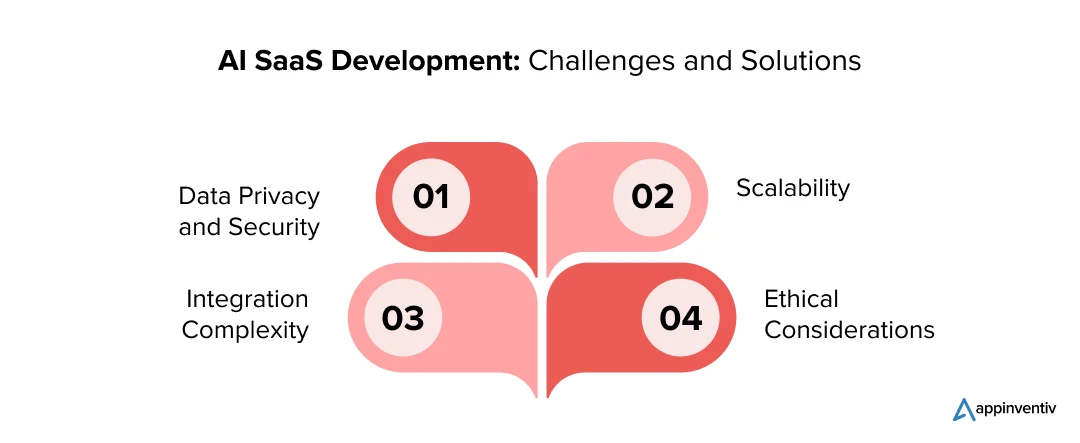

Data Privacy and Security
Challenge: Cloud platforms are often vulnerable to cyber-attacks. Thus, protecting sensitive user data from breaches and maintaining compliance with data protection laws is a real challenge.
Solution: Implement robust security measures such as encryption protocols, multi-factor authentication, etc. additionally, adhere to industry compliances such as GDPR and HIPAA.
Scalability
Challenge: One of the biggest challenges for custom AI SaaS product development is managing the platform’s ability to handle increased user loads, data volumes, and feature expansions without compromising performance.
Solution: Design the platform with a microservices architecture and utilize cloud-based solutions with auto-scaling features. It will help scale up your AI SaaS product and maintain high performance as demand fluctuates.
Integration Complexity
Challenge: Integrating a cloud-based AI SaaS platform with existing systems and ensuring compatibility with various technologies can be a real pain. Poor integration can lead to data silos, creating barriers to effective communication between systems.
Solution: Use standardized APIs and middleware to facilitate smooth integration. A modular system architecture and adherence to common protocols can simplify the integration process and enhance system interoperability.
Ethical Considerations
Challenge: Addressing ethical issues related to AI, such as bias, privacy, and accountability, is a major challenge in AI SaaS development.
Solution: Prioritize transparency in AI SaaS development to ensure responsible AI deployment and build user trust. Also, regular audits should be conducted to identify and mitigate biases in AI models.
You may like reading: A complete guide on cloud-based application development


Future of AI SaaS Product Development: What’s Next?
The future of AI in SaaS is poised to be transformative, driving innovation and offering businesses powerful tools to enhance productivity, efficiency, and customer satisfaction.
As AI technologies like advanced NLP, ML, and computer vision evolve, SaaS platforms will use these advancements to offer more personalized experiences, automate complex tasks, and provide deeper insights with smarter business intelligence tools. This AI integration will not only enhance the functionality of SaaS platforms but also drive their market value by attracting more investment and keeping users engaged longer.
What’s more? Established SaaS companies, such as Salesforce, will intensify their integration of AI to maintain a competitive edge, driving a wave of AI-powered upgrades across their product offerings.
However, the rise of AI-driven SaaS also brings potential risks, such as data privacy concerns, over-reliance on AI insights, and the challenges of integrating AI into existing systems. Companies will need to address these risks carefully to maximize the benefits of AI while maintaining trust and security. As AI advances, it will fuel major innovations in SaaS, leading to new market opportunities and ensuring that AI-enabled SaaS platforms remain competitive in the tech-driven age.
Also Read: A Detailed Guide on How to Get Your SaaS Business on Mobile Apps
Leverage Appinventiv’s Expertise in Artificial Intelligence SaaS Product Development
An AI SaaS product offers numerous advantages over traditional SaaS solutions, including automation, scalability, global accessibility, and enhanced security. However, the journey from an AI SaaS product idea to a scalable product is not easy. It requires careful planning, a strong focus on user needs, and expert assistance from an AI development company.
So, if you are looking for an experienced tech team who can bring your AI SaaS vision to life, Appinventiv is here to help. With a proven track record in developing innovative AI and cloud solutions for various industries, we are adept at creating AI SaaS solutions tailored to meet your stringent business requirements.
Let’s get a glimpse of our expertise in leveraging cutting-edge technologies like IoT, AI, cloud, etc., and building successful SaaS applications.
DiabeticU: A prime example of our expertise is our partnership with DiabeticU, where we tackled scalability challenges, revamped the user interface for better usability, and introduced new features that significantly improved patient engagement and data accuracy. This transformation has empowered users to take control of their health, and DiabeticU has gained significant traction in the healthcare sector.


YKA: Another noteworthy project is YKA, a leading retail and distribution platform in Bahrain. Appinventiv collaborated with YK Almoayyed to build a scalable retail and distribution platform that enhanced operational efficiency and customer engagement. The solution was designed with robust data security measures, ensuring the safe handling of sensitive information while supporting seamless scalability as the business grew. This transformation enabled YK Almoayyed to modernize its operations and maintain a competitive edge in the market.
Avatus: A standout example of our cloud-based product development is Avatus — an avatar-based social networking platform. We designed and developed a scalable infrastructure, implemented sophisticated AI algorithms for personalized content, and integrated interactive features that set Avatus apart in the social networking space. This innovation has attracted a diverse user base and positioned Avatus as a leader in avatar-based social networking.
No matter if you want to build a similar SaaS product or just want to know AI SaaS product development cost, contact us, and we will be happy to assist you with your specific requirements
FAQs
Q. How much does it cost to develop an AI SaaS product?
A. The cost to develop an AI SaaS product typically ranges from $30,000 to $300,000 or more, depending on factors like complexity, features, AI model integration, and specific business requirements.
To get a more precise estimate for AI SaaS product development costs, discuss your project idea with us and get a tailored quotation.
Q. What is the timeline for artificial intelligence SaaS product development?
A. The timeline for developing an AI SaaS product generally ranges between 4 months to a year or more. This timeframe can vary based on several factors, such as the project’s complexity, the integration of AI models, the number of features required, the expertise of the development team, and the iterative testing process.
For a more precise estimate of the AI-powered SaaS product development timeline, connect with our efficient AI experts.
Q. What are the benefits of AI SaaS product development?
A. An AI SaaS product offers numerous advantages. Some of the most common benefits of AI SaaS product development are:
- Enhanced Efficiency: The integration of AI in SaaS product development helps automate routine tasks and streamlines processes, improving operational efficiency.
- Personalization: It delivers personalized experiences based on individual user preferences and behaviors.
- Data-Driven Insights: AI SaaS products provide actionable insights through advanced data analysis, enabling informed decision-making.
- Scalability: SaaS products are made with cloud capabilities. Thus, it can easily adapt to growing user demands, ensuring consistent performance as your business expands.
- Competitive Edge: The integration of AI and cloud in your business software helps you stay ahead in the competitive landscape.
- Strengthened Security: AI SaaS platforms implement robust security measures to protect sensitive data and ensure compliance.
Q. What is an AI SaaS product?
A. An AI SaaS product is a cloud-based software solution that integrates artificial intelligence to provide advanced functionalities, such as automation, data analysis, and personalized user experiences, accessible via the Internet.
link