


GA
Global Advertising Lawyers Alliance (GALA)


With firms representing more than 90 countries, each GALA member has the local expertise and experience in advertising, marketing and promotion law that will help your campaign achieve its objectives, and navigate the legal minefield successfully. GALA is a uniquely sensitive global resource whose members maintain frequent contact with each other to maximize the effectiveness of their collaborative efforts for their shared clients. GALA provides the premier worldwide resource to advertisers and agencies seeking solutions to problems involving the complex legal issues affecting today’s marketplace.
Can you advertise tea bags as having been manufactured in the United States if the tea inside the tea bags was imported? That was the issue in a recent lawsuit in federal court in California.
United States
Media, Telecoms, IT, Entertainment
To print this article, all you need is to be registered or login on Mondaq.com.
Can you advertise tea bags as having been manufactured in the
United States if the tea inside the tea bags was imported? That was
the issue in a recent lawsuit in federal court in California.
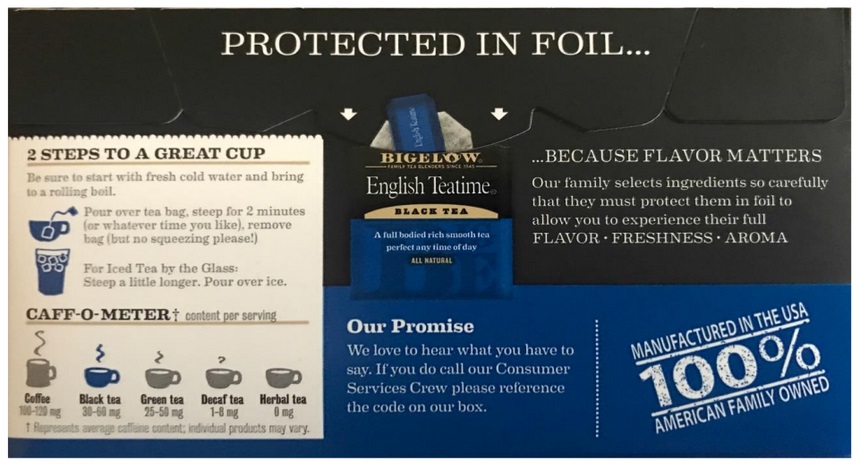
The packaging for Bigelow tea promotes that its tea bags are
“MANUFACTURED IN THE USA.” The tea itself is imported
from India, China, and other countries. The raw tea is also
processed – the “withering, rolling oxidizing, drying,
and sorting” – abroad as well. Apparently, “It is
this foreign processing that determines the resulting type of tea
– green, black, or oolong – and it is this processing
that renders the tea consumable.” Once the tea gets to
Bigelow’s manufacturing facility, the company then blends the
tea and packages the tea in tea bags.
Some consumers sued for false advertising under California law,
arguing that Bigelow’s “manufactured in USA” claim is
literally false because the tea is, in fact, grown and processed
outside of the United States. Plaintiffs later moved for summary
judgment, claiming that the claim is inherently deceptive as a
matter of law. Bigelow argued, on the other hand, that the
“manufactured in USA” statement is true because the tea
bags themselves are, in fact, made in the United States. Bigelow
also argued that the plaintiffs haven’t established that
reasonable consumers would be mislead.
The court granted summary judgment to the plaintiffs, holding
that the “manufactured in USA” statement is literally
false. The court wrote, “the tea leaves inside are vital to
the tea bags as consumers purchase tea for the tea itself. In fact,
the tea leaves are not only a component part of the tea bag; they
are the very essence of the tea bag.”
The issue that Bigelow struggled with in this case is one that
advertisers commonly face. Many companies have substantial
manufacturing operations in the United States. And, to those
companies, it seems to them that their products are, in fact, being
made here. If you’ve got a plant here, lots of employees here,
and you’re actually making the product here, why can’t you
advertise the product as having been “made in the USA”?
The issue is that under both federal and state standards,
advertisers are held to a very high standard when making a
“made in USA” claim. The FTC standard, for example,
requires advertisers to demonstrate that the product is “all
or virtually all” made here. That means that, even if
you’ve got substantial operations here, you’ve got to
consider whether there are any material aspects of the product, or
product costs, that are not of U.S. origin.
Banks v. R.C. Bigelow, Inc., 2024 WL 3330554 (C.D. Cal.
2024).
“the tea leaves inside are
vital to the tea bags as consumers purchase tea for the tea
itself”

The content of this article is intended to provide a general
guide to the subject matter. Specialist advice should be sought
about your specific circumstances.
link