A Look at the Advanced Functional Fabrics of America | Manufacturing Materials

Advanced functional fabrics serve many complex functions.
They transform traditional fibers, yarns and textiles into sophisticated, integrated devices and systems that allow for capabilities including communication, energy storage and health monitoring.
At the forefront of innovation in this space is Advanced Functional Fabrics of America (AFFOA), a public-private partnership founded in 2016 to bridge the gap between product ideation and commercialization. Funded by the Department of Defense (DoD) and one of 18 Manufacturing USA institutes, AFFOA uses its expertise in fibers and fabrics, as well as its ecosystem of 150 members across 38 states, to advance the domestic development of textile-based products with transformative capabilities for defense, health care and consumer applications.
Tackling Tough Tech


Sasha Stolyarov, CEO of AFFOA, says that advanced functional fabrics often take years to advance.
Advanced functional fabrics are in a category known as tough tech, which is comprised of science-based technologies that aim to solve global challenges related to health, climate change, energy and other issues. These tough technologies go beyond typical software development to building new physical infrastructure and industrial systems, often requiring significant research and development, as well as capital, to take breakthrough science out of the lab and into the market.
“In the tough tech space, it takes years to advance,” says Sasha Stolyarov, CEO of AFFOA. “Over the past few years, there have been significant developments in the space of advanced fiber technology. A lot of the capabilities that were in their infancy have reached the stage of commercialization, with products on the market and system-level prototypes being built—not just component technologies, but actually full systems.”
Stolyarov says a good example is from Nanowear Inc., the Brooklyn, N.Y.-based creator of SimpleSense, an FDA-approved remote diagnostic platform that is transforming home-based cardiometabolic health care. SimpleSense wearables deliver a cardiometabolic assessment and a continuous picture of a patient’s health from the comfort of their home. The company says that the noninvasive undergarment monitors multiple patient vitals, such as heart rate, respiration rate, lung volume and physical activity. The collected information generates AI-enabled real-time analytics in the form of easy-to-read reports for physicians, providing a smarter way to care for patients remotely.
Another example is Auburn Manufacturing Inc. (AMI), based in Mechanic Falls, Maine. The company knows a lot about tough tech. They manufacture advanced textiles for extreme-heat environments. AMI also makes flexible barriers, modular insulation kits, reflective aluminized fabrics and fabrics enhanced with coatings to resist oil, moisture and abrasion.
“As a small manufacturer of heat-resistant fabrics, we have come across opportunities that we could not take advantage of due to a lack of in-house resources, such as materials, mechanical engineering, testing, etc.,” says Kathie Leonard, AMI’s president and CEO.
“AFFOA was formed to help specialty textile makers like AMI develop new products that are needed by the DIB (defense industrial base),” she adds. “We were approached by the aerospace industry a few years ago to supply silica fabric used in rockets as an ablative. AFFOA helped us find the proper equipment to further process our silica to meet rigid specifications. They also helped us access federal funding to develop prototype fabrics and to introduce our company to the aerospace industry.”
Stolyarov points to this project as an example of AFFOA working directly with industry to solve a real-world problem. “Silica is critical for many of our military systems, and the U.S. only had one company that could supply that fabric,” he says, citing significant supply chain vulnerability. “AMI tried on their own, but they needed sophisticated equipment and serious engineering horsepower to procure, validate and test the material to make sure it works. Our team worked with them for two years, and we got it going.”
The project enabled AMI to stand up an aerospace-grade silica manufacturing line, creating a much-needed second source for the material in the U.S.
Challenges faced by Leonard and her team include a lack of in-house resources and funding for expansion of their operations, including new hires. She says AFFOA and its membership ecosystem stepped up to the plate to overcome those barriers. “AFFOA’s staff has helped us to coordinate with others within and outside their organization to continue to move forward with automation, workforce training, etc. We are working to become a factory of the future.” As a result of the partnership with AFFOA, AMI has qualified its silica material, grown its workforce and expanded its defense and commercial customer base.
Mission-Ready Military Solutions
According to Military Medicine, musculoskeletal injuries (MSKIs) represent the most substantial and enduring threat to U.S. military readiness, which is defined as the military’s overall health and ability to accomplish its mission. Stolyarov says AFFOA has spent the past few years looking at ways to quantify rehabilitation from MSKIs.
Electroneurography (ENG) is an electrodiagnostic test that measures the function of peripheral nerves and records their electrical response. Stolyarov says that ENG signals have potential use in monitoring injury recovery. However, existing ENG products are made of bands and a rigid puck-like apparatus that makes them clunky, hard to put on and uncomfortable. AFFOA partnered with Pison Technology Inc. to tackle this problem.
Boston-based Pison is known for a wrist-worn wearable that uses ENG signals recorded at the surface of the wrist to control various devices, such as phones or drones, through hand gestures. “If you take that basic component and put it on the lower leg,” Stolyarov explains, “you can pick up small muscular signals on the leg. If you look at a collection of those signals, you can get information, such as if the leg is giving normal, injury-free signals.”
The manufacturing process uses an embroidery machine to stitch conductive threads onto fabric for communication pathways and power. Soft electrodes contact the body and pick up electrical signals. The team engineered a full soft-system integration scheme using distributed ENG textile-sensor architecture to create a fabric-based system in a compression sleeve.
The best part? It’s actually comfortable. So far, 10 compression sleeve prototypes have been produced and validated, and the sleeves are currently being evaluated by U.S. Army service members.
“This is an example of being able to combine disparate elements of electronics with fabrics to create fully integrated systems,” Stolyarov says, sharing that the project helped AFFOA address some barriers to commercialization of other electronic-textile products.
Empowering an Ecosystem

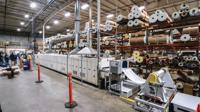
Auburn Manufacturing Inc. produces silica fabric with the help of AFFOA’s manufacturing process team. This material is critical to the U.S. military and aerospace industry.
“The ability to do these types of projects rapidly came about because of the infrastructure advances AFFOA has made in the past three years,” he says. One example is the universal development platform (UDP), which serves as a development kit to remove the burden of creating new hardware or software platforms every time there is a new idea for sensing modality. “We can reuse the UDP to support a whole line of sensors, from temperature to strain to heart-rate monitoring, all through a consistent set of hardware and software. That never existed before. Now industry can leverage it, and AFFOA uses it internally to do rapid development.” The UDP is soft-system-integration ready, and the architecture provides configurability and scalability, he adds.


Silica fabric is used in rockets as an ablative.
AFFOA also developed infrastructure resources for foundational e-textile elements. These include a database of documented conductors, encapsulants and electrical connections. AFFOA is also looking at design rules for manufacturing so its members can have tools to make rapid progress toward commercialization, Stolyarov says.
“People want to create scalable functional-fabric solutions, but there’s a whole host of challenges our members face. AFFOA looks to fill gaps and support where we can,” he explains. “People want to try something, but they struggle with getting prototypes made. If you think about manufacturing, it’s very costly to stop and try something risky. That’s a big barrier for advancement, especially for startups that don’t have a rich infrastructure or equipment for prototyping. That’s where we come in.”
To address the barrier of limited market connections, especially with domestic partners, AFFOA helps members identify and collaborate with U.S. manufacturers that have relevant capabilities. Stolyarov says annual membership summits play a key role in making valuable connections for a startup with a great product to get in front of the right potential customer, such as the DoD or a large organization that might want to buy the product or license the technology.
Preparing the Next-Gen Workforce


Embroidered circuitry forms a stitched interface between hard printed circuit boards and soft garment components, integrating systems into apparel and other textiles.
A commitment to workforce development is an area where AFFOA is making strides, Stolyarov reports. An assessment survey, as well as site visits and interviews with CEOs and workforce leaders at dozens of organizations, identified industry challenges related to recruiting and skills development. The insights informed an education and workforce development roadmap with five focus areas:
- Expand the high school/career and technical education (CTE) program suite for the new/emerging workforce.
- Establish a training and upskilling program suite for existing and emerging workforce needs.
- Build textile industry awareness and share workforce-development best practices.
- Grow a suite of programs to support interdisciplinary engineers, designers and innovators.
- Develop a model for the modernization of the industry through a Facilities + Workforce Innovation Hub.

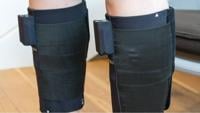
Calf sleeves designed by Pison Technology and AFFOA for an Army Phase 2 Small Business Innovation Research Award.
For example, one project will focus on developing fabric products for military tactical-gear applications, leveraging sew-free adhesive material. Goals include improving comfort and fit, conductive thread and bus encapsulation, and manufacturability of tactical gloves. AFFOA also plans to establish a scalable CTE training toolkit to bridge the gap between textile product design and manufacturing that allows student to learn in-demand skills.
Education programs partner with universities and high schools nationwide to get students exposed to functional fabrics and the realities of the industry. The aim is to cover key textile regions and connect hands-on learning with manufacturing or industry employers in local communities.
Late last year, AFFOA moved into a new headquarters in Bedford, Mass., with facilities designed to expand collaboration with partners across innovation and education priorities. The capabilities contained in the new end-to-end advanced fibers and fabrics prototyping facility reflect the ongoing diversification of AFFOA’s customer base. AFFOA currently has dozens of contracts across different government organizations and commercial entities seeking help and support, and functions as a self-sustaining business model.
As innovation, supply chain and workforce priorities move forward, AFFOA continues to play a critical role in helping the U.S. advance technology and manufacturing readiness, unleashing the power of advanced textiles—from functional materials to breakthrough applications across industries.
“Many industries, like textiles, have been left behind due to offshoring of manufacturing,” AMI’s Leonard asserts. “In the mid-2010s, the creation of institutions like AFFOA was set up and funded by the U.S. government to strengthen manufacturing. We are grateful for that, and we’re trying our best to be an example of what we can do with a little more help.”

link